
The job market is changing faster than ever. Automation, artificial intelligence and remote work have reshaped how companies hire, and the skills that guaranteed a stable career ten years ago are no longer enough on their own. The good news is that the most valuable skills today can be learned online, at your own pace, without an expensive degree. The challenge is knowing where to focus your time and energy.
In this article, we break down the top ten tech skills employers are actively looking for in 2026, why each one matters, who it suits best and how you can start learning it. Use this list as a map, not a checklist. You do not need all ten. You need the one or two that fit your interests and goals, learned deeply enough to create real value.
Why Skills Matter More Than Degrees Today
Many employers now practise skills-based hiring. Instead of filtering candidates only by degree, they ask a simpler question: can this person do the work? A strong portfolio, a few finished projects and a recognised certificate often carry as much weight as formal qualifications, especially in technology roles.
This shift is great news for self-driven learners. It means a motivated student in a small town, a homemaker returning to work or a professional changing careers can compete for the same opportunities as anyone else, as long as they build practical, provable skills.
1. Web Development
Every business needs a website, and most need web applications too. Web development remains one of the most accessible and versatile tech skills. Front-end developers build what users see using HTML, CSS and JavaScript, while back-end developers handle servers, databases and business logic with languages such as PHP, Python or Node.js.
If you are a complete beginner, PHP is a particularly friendly starting point because it is easy to set up and shows results instantly. Our complete roadmap for a PHP course for beginners explains exactly what to learn and in what order. For the bigger picture, read our web development career guide.
2. Artificial Intelligence and Prompt Engineering
AI tools are now part of everyday work in marketing, customer support, software development and design. Companies value people who can use these tools effectively: writing clear prompts, checking outputs for accuracy, and building simple automations. You do not need to be a research scientist to benefit. Understanding how AI models work and where they fail is already a strong advantage.
3. Data Analysis
Organisations collect huge amounts of data, but data is only useful when someone can turn it into decisions. Data analysts clean information, find patterns and present insights through dashboards and reports. Key tools include spreadsheets, SQL, Python and visualisation software. Data analysis suits people who enjoy puzzles, numbers and storytelling with facts.
4. Cloud Computing
Most modern applications run in the cloud rather than on physical office servers. Cloud skills include deploying applications, managing storage, configuring networks and controlling costs. Entry-level certifications from major cloud providers are widely recognised and can open doors to well-paid infrastructure and DevOps roles.
5. Cybersecurity
As more of life moves online, protecting data has become a top priority for every organisation. Cybersecurity professionals identify vulnerabilities, monitor threats and respond to incidents. Even developers benefit from basic security knowledge, such as validating input, storing passwords safely and keeping software updated. The demand for security talent continues to outpace supply.
6. Digital Marketing
Businesses live and die by their online visibility. Digital marketing combines search engine optimisation, social media, content strategy, email campaigns and paid advertising. It is an excellent choice for creative people who also like measuring results. Pairing marketing with basic web or data skills makes you especially valuable to small businesses and startups.
7. UI and UX Design
Good design is no longer a luxury; it is how products win customers. UI designers focus on how an interface looks, while UX designers focus on how it works and feels. Skills include user research, wireframing, prototyping and usability testing. Design is ideal for visual thinkers who care about people and enjoy solving problems through empathy.
8. Mobile App Development
People spend hours every day on their phones, so businesses want apps that are fast, reliable and easy to use. Mobile developers build for Android, iOS or both using cross-platform frameworks. If you already know web development, moving into mobile is often easier than you expect, because many concepts carry over directly.
9. Automation and Low-Code Tools
Not every valuable tech skill requires deep programming. Low-code and no-code platforms let you automate workflows, connect apps and build internal tools quickly. Professionals in operations, HR and finance who learn automation can save their teams hundreds of hours a year, which makes them stand out in any organisation.
10. Communication and Problem Solving
The most underrated tech skills are not technical at all. Clear writing, active listening, teamwork and structured problem solving determine how far you go in any role. Employers repeatedly say they can teach tools, but they struggle to find people who communicate well and take ownership of problems. Practise explaining your projects in simple language; it will help in every interview.
How to Choose the Right Skill for You
With so many options, it is easy to feel stuck. Ask yourself a few honest questions:
- What do I enjoy? Building things, analysing numbers, designing visuals or persuading people?
- What is my starting point? Some skills, like web development and digital marketing, are very beginner-friendly.
- How much time can I commit each week? Be realistic so you can stay consistent.
- What kind of work do I want? A full-time job, freelancing, remote work or growing your own business?
Once you have a direction, pick one structured course and commit to finishing it before jumping to something else. Our step-by-step guide on how to choose the right online course helps you compare syllabuses, instructors, projects and certificates so you invest your time wisely.
Building a Learning Plan That Works
Knowing what to learn is only half the battle. The other half is actually learning it. A simple plan looks like this:
- Set a clear goal. For example: "Build and publish three web projects in the next four months."
- Break it into weekly milestones. Each week should end with something you can show, even if it is small.
- Schedule fixed study time. Treat it like an appointment you cannot cancel.
- Practise more than you watch. Aim to spend at least half of your study time writing code, designing or analysing real data.
- Share your progress. Post projects online, ask for feedback and connect with other learners.
If you find it hard to stay focused when learning online, our article on effective study habits for online learners shares proven techniques such as time blocking, active recall and spaced repetition.
Combining Skills for Maximum Impact
The most successful professionals rarely rely on a single skill. They combine two or three complementary abilities into a unique profile. A web developer who understands digital marketing can build sites that actually attract customers. A data analyst with design skills can create dashboards people love to use. A marketer who knows automation can run campaigns that would normally need a whole team.
Start with one core skill, become genuinely good at it, and then add a supporting skill that multiplies its value. This approach makes you harder to replace and far more interesting to employers and clients.
Pick one skill, finish one course and build one project. Momentum beats perfection every single time.
Final Thoughts
The tech skills in highest demand in 2026 are web development, AI literacy, data analysis, cloud computing, cybersecurity, digital marketing, design, mobile development, automation and strong communication. Each offers a real path to better opportunities, and every one of them can be learned online.
Do not let the length of this list overwhelm you. Choose the skill that excites you most, follow a structured path, practise consistently and build projects you can proudly show. A year from now, you will be glad you started today.
Keep reading
 Programming
PHP Course for Beginners: A Complete Roadmap to Start Coding in 2026
Everything you need to know before starting PHP: what to learn, how long it takes, common mistakes and where PHP can take your career.
Read article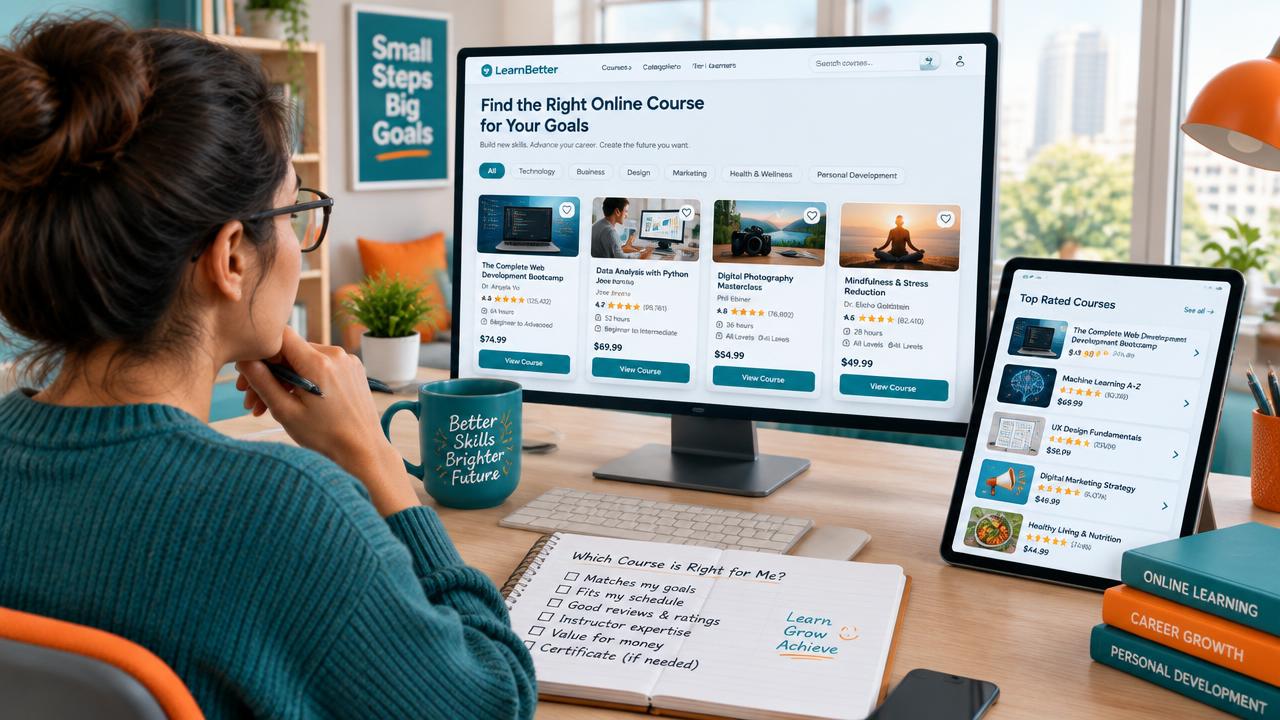 Learning
How to Choose the Right Online Course for Your Career Goals
A practical 9-step framework to compare syllabuses, instructors, projects and certificates so you pick a course you will actually finish.
Read article Careers
Web Development Career Guide: From Beginner to Job-Ready
A step-by-step path from HTML and CSS to back-end, databases, portfolio projects and interviews for aspiring web developers.
Read article